Step 1
Machine-Ready Briefs
AI translates unstructured needs into a technical, machine-ready project request.
We use cookies to improve your experience and analyze site traffic. You can accept all cookies or only essential ones.
 Bilarna
Stop browsing static lists. Tell Bilarna your specific needs. Our AI translates your words into a structured, machine-ready request and instantly routes it to verified AI Development Platforms experts for accurate quotes.
AI translates unstructured needs into a technical, machine-ready project request.
Compare providers using verified AI Trust Scores & structured capability data.
Skip the cold outreach. Request quotes, book demos, and negotiate directly in chat.
Filter results by specific constraints, budget limits, and integration requirements.
Eliminate risk with our 57-point AI safety check on every provider.
Verified companies you can talk to directly
Flatlogic builds AI-powered software for startups and businesses - production-ready SaaS, CRMs, ERPs and custom business apps
Appaca is a no-code platform for creating end-user AI agents and tools that you can monetize. Turn your AI ideas into products your customers actually use.
⌘ Langbase is the Serverless AI developer platform and developer experience to build, collaborate, and deploy any AI agents, apps, and AI features. The most powerful serverless platform for building AI products. Our mission is to make AI accessible to everyone, any developer not just AI/ML experts. We are the only Serv

AI Workspace - The Ultimate Frontend for AI Models. Connect to Claude, GPT-4, Gemini, Grok and more. Create custom agents, manage prompts, and collaborate with your team.
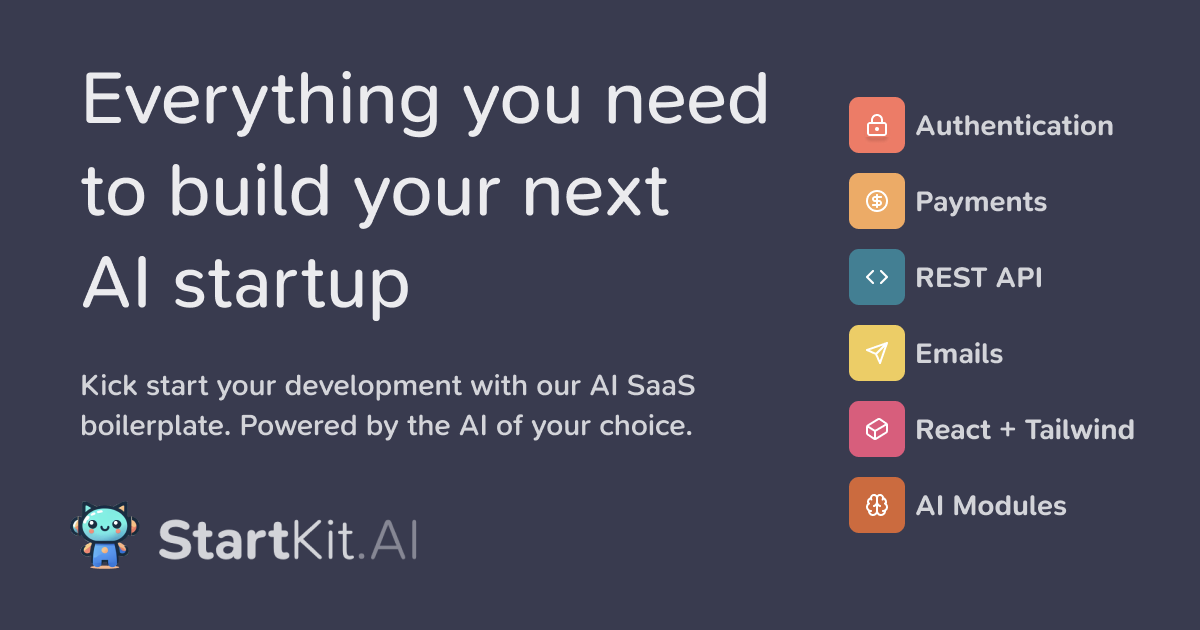
Launch your AI product 100x faster with StartKit's boilerplate code. Includes user authentication, rate-limits, all OpenAI APIs, and more.
Launch your AI startup quickly using our Next.js templates and boilerplate code - everything you need in one place

The fastest developer experience for building on open source AI.
Developer Tools for Large Language Models

Build full-stack applications with AI that go beyond demos. With real debugging tools and production features, Pythagora helps you launch apps that actually work.
Run sandboxes, inference, and training with ultrafast boot times, instant autoscaling, and a developer experience that just works.
Open source generative AI development platform for building AI agents, LLM orchestration, and more

Rowboat is an open-source AI IDE that helps you build, deploy and manage agent systems.

The AI engineering platform
Comet provides an end-to-end model evaluation platform for AI developers, with best-in-class LLM evaluations, experiment tracking, and production monitoring.
Run a free AEO + signal audit for your domain.
AI Answer Engine Optimization (AEO)
List once. Convert intent from live AI conversations without heavy integration.
AI development platforms are integrated software environments that provide the tools, frameworks, and infrastructure necessary to build, train, deploy, and manage artificial intelligence models and applications. They consolidate capabilities like data preprocessing, model training, MLOps, and deployment pipelines into a unified workflow. This accelerates time-to-market for AI solutions, reduces technical complexity, and ensures scalable, production-ready outcomes.
You first specify your technical stack, data requirements, desired AI capabilities, and integration needs for your development project.
You then assess providers based on their tooling, supported frameworks, scalability, security features, and MLOps support.
Finally, you onboard the chosen platform to streamline your team's workflow for model development, testing, and deployment.
Banks use these platforms to build and deploy real-time machine learning models that identify anomalous transactions and prevent fraudulent activities.
Medical institutions leverage them to develop AI models that analyze medical imaging data, aiding in faster and more accurate patient diagnoses.
Retailers employ these platforms to create recommendation engines that personalize product suggestions, boosting conversion rates and average order value.
Manufacturers utilize the platforms to develop models that predict equipment failures from IoT sensor data, minimizing unplanned downtime.
Software companies integrate AI development platforms to add advanced features like natural language processing or predictive analytics to their products.
Bilarna evaluates every AI Development Platforms provider using a proprietary 57-point AI Trust Score. This comprehensive assessment covers technical expertise, project portfolio depth, client satisfaction metrics, and security compliance. We continuously monitor performance to ensure all listed partners maintain our standards for reliability and quality.
Costs vary widely based on features, scale, and deployment model, typically ranging from monthly SaaS subscriptions to enterprise licensing. Pricing is often tiered by compute resources, number of users, and levels of support and advanced MLOps capabilities.
Prioritize platforms that align with your team's technical skills, integrate with your existing data stack, and offer robust model management tools. Key selection criteria include supported frameworks, scalability, security certifications, and the quality of vendor support.
AI development platforms offer an integrated, end-to-end environment covering the entire AI lifecycle, from data to deployment. Traditional tools often focus on isolated tasks like analysis or modeling, requiring significant manual integration for production workflows.
Initial setup and integration can take several weeks, depending on complexity. Time-to-value accelerates significantly thereafter, with teams often deploying initial models within months, leading to faster iteration and ROI on AI projects.
Common pitfalls include underestimating data preparation needs, neglecting MLOps and governance features, and choosing a platform misaligned with internal skill sets. A phased implementation with clear success metrics is crucial for avoiding these issues.
To understand data upload limits and payment requirements on analytics platforms, follow these steps: 1. Review the platform's account types, such as free and paid plans. 2. Check the data upload limits for each plan; free accounts often have row limits per upload. 3. Determine if a credit card is required for free or paid accounts. 4. Understand the cancellation policy for paid subscriptions, which usually allows cancellation at any time.
Many creator marketing platforms offer flexible subscription models without mandatory minimum periods or binding contracts. Users can often cancel their subscriptions at any time through their account settings. This flexibility allows brands to adapt their marketing strategies as needed without long-term commitments. It is important to review the specific platform's terms to understand cancellation policies and any potential fees, but generally, these platforms aim to provide user-friendly and commitment-free access.
AI code review platforms can significantly enhance team collaboration and code quality. By providing automated, objective feedback on code changes, these platforms reduce misunderstandings and subjective opinions during reviews. They help establish and enforce coding standards consistently across the team, ensuring everyone follows best practices. The faster identification of bugs and issues allows teams to address problems promptly, reducing technical debt. Moreover, AI tools facilitate knowledge sharing by highlighting code patterns and potential improvements, fostering a culture of continuous learning and collaboration among developers.
Yes, AI code review tools typically integrate seamlessly with popular version control platforms such as GitHub and GitLab. This integration allows automatic review of pull requests within the existing development workflow. Many tools support a wide range of programming languages including Python, JavaScript, TypeScript, Go, Java, C, C++, C#, Swift, PHP, Rust, and others. While support for some languages may vary in response quality, these tools aim to provide comprehensive analysis across diverse codebases, helping teams maintain code quality regardless of their technology stack.
AI compliance platforms are designed to complement, not replace, customs brokers in the import process. These platforms provide automated audits and classification recommendations to identify errors and potential savings, but they do not file customs entries, corrections, or paperwork with customs authorities. Licensed customs brokers remain essential for submitting filings and handling official communications. The AI platform offers defensible evidence and insights that brokers can use to improve accuracy and compliance, enhancing the overall import process without substituting the broker's role.
Yes, AI customer service platforms are designed to support multilingual communication, often covering over 50 languages. They can automatically translate incoming messages and responses, enabling customer service teams to communicate confidently with a diverse global customer base. This multilingual capability helps maintain consistent brand tone and messaging across different channels and languages. Additionally, intelligent assistance and smart human handover features ensure complex or sensitive cases are escalated to human agents when necessary, preserving service quality regardless of language barriers.
Yes, AI localization platforms can manage translation projects and integrate existing translation memories. 1. They provide content editors to manage source texts and translation strings with context features like glossaries and screenshots. 2. They support major translation memory formats allowing seamless migration of existing databases. 3. Imported translation memories improve AI translation quality by leveraging previous work. 4. Platforms enable manual submission of files or full workflow integration for automation. 5. This facilitates efficient project management, quality control, and scalability in localization.
Yes, AI marketing platforms can generate professional model photoshoots without hiring models or studios. 1. Upload your product images or specify fashion items. 2. Choose model types, poses, and settings from AI options. 3. Customize styles to align with your brand identity. 4. Generate high-quality model photoshoots instantly. 5. Use the images for fashion marketing, e-commerce, or virtual try-ons without additional costs or logistics.
Yes, AI planning platforms are designed to integrate seamlessly with existing trucking management tools and portals. This means there is no need to replace current systems, allowing fleets to enhance their operations without disrupting established workflows. Integration is typically facilitated through pre-built connectors that link the AI platform with the fleet's existing data sources and software. This approach enables a fast start and real impact, as fleets can deploy AI-driven planning solutions risk-free and begin seeing results within a short timeframe, often within a month. Continuous support is also provided to ensure smooth integration and ongoing optimization.
Yes, AI sales tools are designed to integrate seamlessly with existing CRM and marketing platforms such as Salesforce, Hubspot, Outreach, and Salesloft. This integration allows sales teams to access all relevant buyer signals, account scores, and outreach tasks directly within their familiar tools, eliminating the need to switch between multiple applications. It streamlines workflows by automatically queuing tasks and personalized emails, improving efficiency and reducing manual research. Additionally, synchronized updates across advertising, sales outreach, and CRM ensure coordinated engagement with prospects. This unified approach enhances team adoption, accelerates pipeline development, and ultimately drives better sales outcomes.