Step 1
Machine-Ready Briefs
AI translates unstructured needs into a technical, machine-ready project request.
We use cookies to improve your experience and analyze site traffic. You can accept all cookies or only essential ones.
 Bilarna
Stop browsing static lists. Tell Bilarna your specific needs. Our AI translates your words into a structured, machine-ready request and instantly routes it to verified Architectural Visualization experts for accurate quotes.
AI translates unstructured needs into a technical, machine-ready project request.
Compare providers using verified AI Trust Scores & structured capability data.
Skip the cold outreach. Request quotes, book demos, and negotiate directly in chat.
Filter results by specific constraints, budget limits, and integration requirements.
Eliminate risk with our 57-point AI safety check on every provider.
Verified companies you can talk to directly
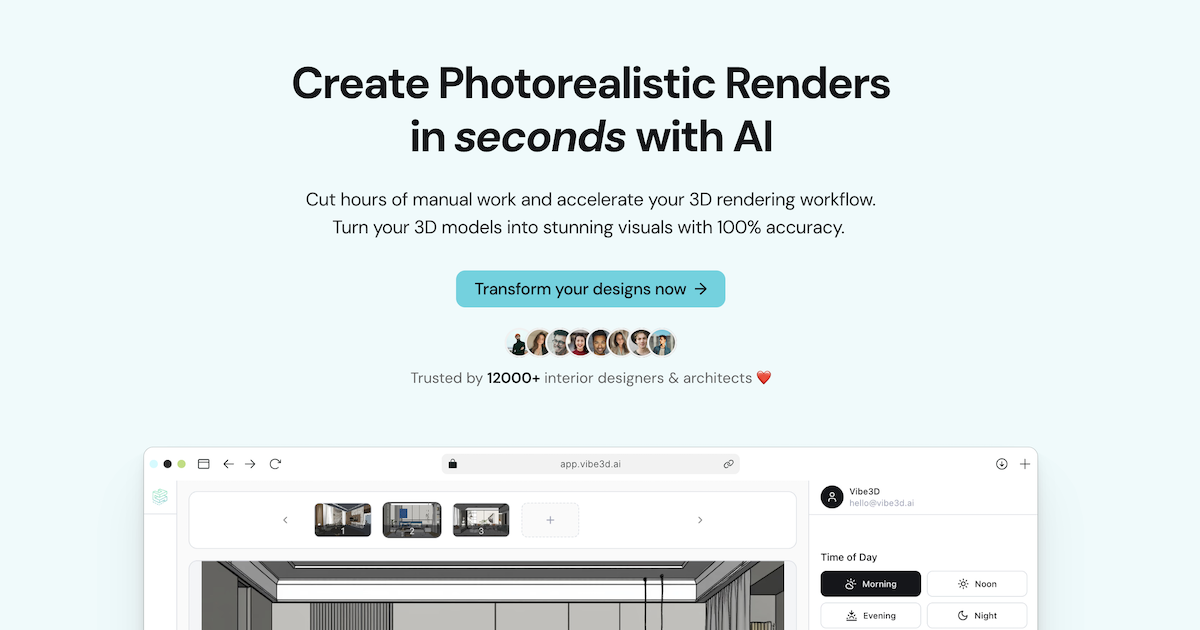
Best AI Interior Design and Architectural 3D Rendering software. Instantly create realistic 3D renders from SketchUp, 3ds Max, Revit, Archicad, Rhino & more.

Create stunning architectural renders in seconds. No 3D skills required. Join 600k+ architects using ArchiVinci to visualize interiors, exteriors, and landscapes.
Run a free AEO + signal audit for your domain.
AI Answer Engine Optimization (AEO)
List once. Convert intent from live AI conversations without heavy integration.
Architectural visualization is the process of creating photorealistic images, animations, or virtual tours from architectural plans. This service utilizes specialized 3D software for modeling, lighting, and texturing to create a compelling visual narrative. The result is precise representations that secure investor buy-in, enable market analysis, and help identify construction issues early.
The process begins by analyzing technical drawings, material specifications, and the desired visual style for the project.
Specialists create a digital 3D model and apply photorealistic lighting, materials, and textures to generate high-fidelity imagery.
Final visualizations are delivered in agreed formats such as still images, animations, or interactive VR experiences.
Pre-sales visualizations build confidence with investors and buyers before physical construction begins on site.
Large-scale visualizations demonstrate the impact of new infrastructure projects on cityscapes for public consultation.
Detailed interior renderings aid in selecting furniture, lighting, and color palettes prior to renovation.
Product visualizations, such as for kitchens or windows, are placed in realistic settings for marketing catalogs and websites.
Historical reconstructions or visualizations of new museum builds support fundraising and approval processes.
Bilarna evaluates architectural visualization providers using a proprietary 57-point AI Trust Score that measures expertise and reliability. The vetting includes a detailed portfolio review, validation of client references, and assessment of technical proficiency with specific 3D software. Bilarna also continuously monitors performance and client satisfaction to list only trustworthy partners.
Costs vary widely based on complexity, style, and scope. A simple room rendering can start from $500, while extensive animation projects for large developments can cost $10,000 or more. Pricing is influenced by detail level, resolution, and turnaround time.
Production time for a high-quality rendering typically takes 3 to 7 business days, depending on scene complexity and requested revisions. More extensive projects like animation films or virtual tours can take several weeks to months.
A 3D rendering is a static, highly detailed image of a scene. An animation is a sequence of renderings that creates a filmed walkthrough or object presentation. While renderings are ideal for stills, animations are better for dynamic presentations of spaces or processes.
Professional providers ideally work with CAD files like DWG or DXF, BIM models (IFC, RVT), or even sketches and floor plans. Common delivery formats are high-resolution JPEG or PNG images, TIFF for print, and MP4 for animations or interactive EXE/WebGL files.
Evaluate their portfolio for realism and style diversity, check references from your industry, and clarify the workflow for feedback and revisions. Ensure the provider is proficient with software relevant to your project (e.g., 3ds Max, V-Ray, Lumion, Unreal Engine).