Step 1
Machine-Ready Briefs
AI translates unstructured needs into a technical, machine-ready project request.
We use cookies to improve your experience and analyze site traffic. You can accept all cookies or only essential ones.
 Bilarna
Stop browsing static lists. Tell Bilarna your specific needs. Our AI translates your words into a structured, machine-ready request and instantly routes it to verified AI Voice Cloning Services experts for accurate quotes.
AI translates unstructured needs into a technical, machine-ready project request.
Compare providers using verified AI Trust Scores & structured capability data.
Skip the cold outreach. Request quotes, book demos, and negotiate directly in chat.
Filter results by specific constraints, budget limits, and integration requirements.
Eliminate risk with our 57-point AI safety check on every provider.
Verified companies you can talk to directly
.png)
High-quality Free AI Voice Cloning in just a few seconds. Upload an Audio Sample, and generate a custom voice instantly.

Free AI voice cloning with Higgs Audio - the best voice cloning ai platform online. Advanced voice cloning technology for instant voice cloning, open source voice cloning, and professional cloning voice results.
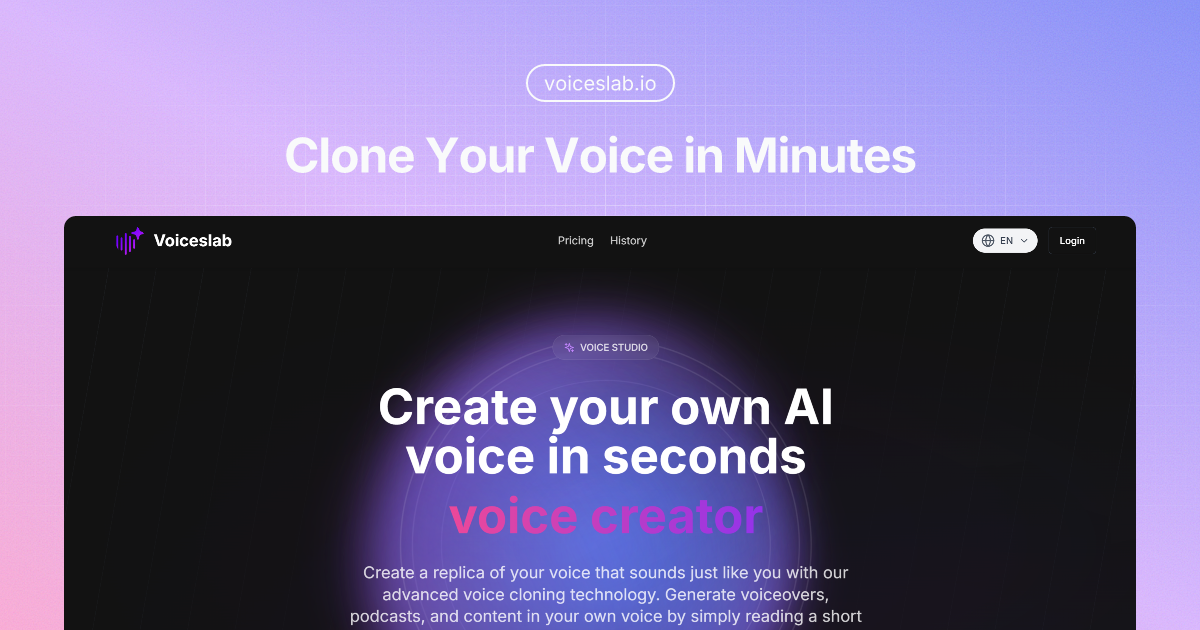
Make an AI copy of your voice that keeps your tone and accent. Our voice cloning tech lets you create natural-sounding speech for videos and podcasts by reading a short text.
Run a free AEO + signal audit for your domain.
AI Answer Engine Optimization (AEO)
List once. Convert intent from live AI conversations without heavy integration.
AI voice cloning is the process of creating a synthetic, digital replica of a human voice using machine learning models. The technology analyzes speech patterns, tone, and intonation from source audio to generate new speech that mimics the original speaker. This enables businesses to produce voice content at scale while maintaining brand consistency and personalization.
High-quality audio samples of the target voice are gathered and processed to train the AI model effectively.
Neural networks analyze phonetic patterns and vocal characteristics to build a digital voice profile capable of generating new speech.
The cloned voice is integrated into applications, such as IVR systems, virtual assistants, or media production tools, for operational use.
Producers clone voices for dubbing, audiobook narration, and video game characters, ensuring consistency and reducing reliance on voice actors.
Contact centers deploy cloned brand voices for interactive voice response systems, providing a familiar and consistent customer experience.
Educational platforms use cloned instructor voices to generate scalable, multilingual course content and personalized learning modules.
Brands create personalized audio ads and dynamic voiceovers at scale, maintaining vocal brand identity across campaigns.
Assistive devices and applications offer synthesized voices for individuals who rely on speech-generating technologies for communication.
Bilarna evaluates every AI voice cloning provider through our proprietary 57-point AI Trust Score, assessing technical expertise, data security compliance, and project delivery history. We verify client references, review sample outputs for quality, and monitor ongoing performance to ensure listed vendors meet enterprise standards. This rigorous screening allows B2B buyers to engage with confidence on our platform.
Costs vary significantly based on project scope, voice quality requirements, and licensing terms. Entry-level projects may start in the low thousands, while enterprise-grade solutions with full ownership can reach tens of thousands. Pricing is typically structured around development hours, compute resources, and usage-based licensing.
Standard text-to-speech uses generic, pre-built synthetic voices, while AI voice cloning creates a unique digital replica of a specific person's voice. Cloning captures unique timbre, accent, and emotional cadence, enabling brand-specific or personalized audio outputs that generic TTS cannot replicate.
The timeline depends on data quality and model complexity. A basic clone can be ready in 1-2 weeks with sufficient high-quality audio. Enterprise-grade clones requiring extensive training, fine-tuning, and integration may take 4-8 weeks from data collection to deployment-ready deliverables.
Providers need clean, high-fidelity audio samples (typically 30 minutes to 3 hours), clear licensing rights for the source voice, and specific output format requirements. The technical infrastructure must support secure data handling, model training with GPUs, and scalable synthesis for production environments.
Key mistakes include overlooking data security and privacy compliance, not verifying output quality with diverse scripts, and neglecting long-term licensing terms. Ensure the provider has proven experience in your specific use case and offers clear benchmarks for voice realism and emotional range.
Yes, AI voice and SMS agents designed for healthcare are built with security and compliance in mind. They adhere to industry standards and regulations such as HIPAA (Health Insurance Portability and Accountability Act) to protect patient data privacy and security. Business Associate Agreements (BAAs) are available to formalize compliance commitments. Additionally, these agents comply with regulations like TCPA (Telephone Consumer Protection Act) and PCI (Payment Card Industry) standards where applicable. Ensuring security and regulatory compliance is critical to maintaining trust and safeguarding sensitive healthcare information while leveraging AI technologies.
Yes, AI voice agents are designed to manage unlimited hotel guest calls around the clock without any downtime. Unlike human staff, these agents can simultaneously process multiple calls, ensuring that no guest inquiry goes unanswered regardless of the time or call volume. This capability helps hotels maintain high service levels during peak hours and off-peak times alike. Continuous availability also means guests can receive assistance whenever needed, improving overall satisfaction. The scalability of AI voice agents makes them an effective solution for hotels of all sizes aiming to provide consistent and reliable guest communication.
Yes, you can customize voice and language settings in an AI voice generator by following these steps: 1. Access the AI voice generator interface. 2. Locate the voice selection menu and choose from available voice options. 3. Select the preferred language for the speech output. 4. Adjust additional settings such as speech speed, pitch, and tone if available. 5. Preview the voice to ensure it meets your requirements before generating the final audio.
Yes, you can customize the voice generated from your social media profile. Follow these steps: 1. Use the voice design tool to generate the initial voice. 2. Access customization options such as pitch, speed, and tone. 3. Adjust the settings to match your preferences. 4. Preview the customized voice output. 5. Save the customized voice for future use or export.
Yes, you can use an AI voice generator to create voice content in multiple languages. Follow these steps: 1. Select the desired language from the language options provided. 2. Choose a voice or celebrity voice that supports the selected language. 3. Enter the text in the chosen language. 4. Generate the voice output. 5. Download or share the multilingual voice content as needed.
Yes, you can use the AI voice changer for real-time dubbing in any application by following these steps: 1. Install and open the AI voice changer software on your PC or Mac. 2. Configure the software to capture your microphone input and output the modified voice. 3. Set the AI voice changer as the default audio input device in the target application. 4. Choose the desired AI voice and language for dubbing. 5. Start speaking to hear your voice transformed instantly within the application. 6. Use this setup for live streaming, gaming, calls, or any platform supporting audio input.
Yes, voice AI systems can support multiple languages to facilitate global customer interactions. These systems are designed to be globally accessible and can conduct fluent conversations in almost any language preferred by customers. This multilingual capability ensures that businesses can provide consistent and effective support to a diverse customer base across different regions. By adapting to various languages, voice AI enhances customer engagement and satisfaction, making communication seamless regardless of geographic location.
Modern AI voice agents for customer service are designed to sound natural, conversational, and professional, not robotic. They utilize advanced natural language processing (NLP) and text-to-speech technologies that produce a warm, human-like tone. Key aspects that ensure naturalness include the AI's ability to understand context, manage conversational flow, and respond with appropriate empathy or professionalism. The voice and communication style can be customized to align with a brand's specific identity, whether that's friendly, formal, or somewhere in between. In practice, when properly implemented, many callers cannot distinguish the AI agent from a human representative, leading to more positive and efficient customer interactions.
Yes, creating an account is usually required for personalized access. 1. Download and open the app. 2. Choose to sign up using quick options like Apple or Google accounts. 3. Complete the registration with minimal steps. 4. Access voice input features to dictate ingredients. 5. Save your personalized recipes and preferences securely.
No additional apps or software installations are required to use an AI transcription service for WhatsApp voice messages. Follow these steps: 1. Use WhatsApp as usual on your device. 2. Forward the voice message you want transcribed directly within WhatsApp to the AI transcription service. 3. Receive the text transcription back within the same WhatsApp chat. 4. Read the transcription instantly without leaving WhatsApp. This seamless integration eliminates the need for any extra downloads or setups.