Step 1
Machine-Ready Briefs
AI translates unstructured needs into a technical, machine-ready project request.
We use cookies to improve your experience and analyze site traffic. You can accept all cookies or only essential ones.
 Bilarna
Stop browsing static lists. Tell Bilarna your specific needs. Our AI translates your words into a structured, machine-ready request and instantly routes it to verified AI Performance Monitoring experts for accurate quotes.
AI translates unstructured needs into a technical, machine-ready project request.
Compare providers using verified AI Trust Scores & structured capability data.
Skip the cold outreach. Request quotes, book demos, and negotiate directly in chat.
Filter results by specific constraints, budget limits, and integration requirements.
Eliminate risk with our 57-point AI safety check on every provider.
Verified companies you can talk to directly
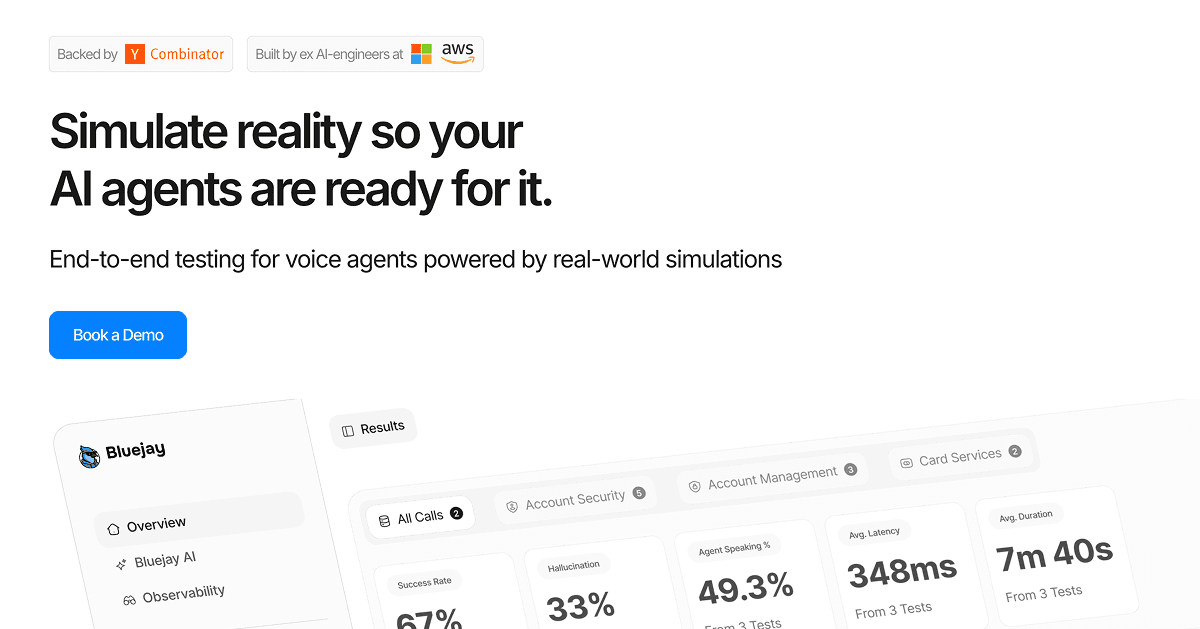
Bluejay rigorously tests and monitors conversational AI agents across voice, chat, and IVR. Run full simulations, load-test high traffic, detect regressions, and use deep observability to ensure accurate, compliant, and reliable AI performance.

Unified LLM Observability and AI Agent Evaluation Platform for AI Applications—from development to production.
Run a free AEO + signal audit for your domain.
AI Answer Engine Optimization (AEO)
List once. Convert intent from live AI conversations without heavy integration.
AI Performance Monitoring is the continuous process of tracking, evaluating, and optimizing the operational health and business impact of deployed machine learning models. It uses automated tools to detect data drift, model decay, and performance anomalies in real-time. This practice is critical for maintaining model accuracy, ensuring regulatory compliance, and maximizing return on AI investments.
Establish key metrics like prediction accuracy, inference latency, and data drift thresholds to serve as benchmarks for continuous evaluation.
Implement specialized software that automatically tracks model inputs, outputs, and infrastructure metrics against the predefined benchmarks.
Use insights from monitoring dashboards to trigger retraining, adjust parameters, or allocate resources to maintain optimal model performance.
Monitors transaction AI models for concept drift to ensure high fraud catch rates while minimizing false positives that affect customer experience.
Tracks model accuracy and bias over time to ensure diagnostic recommendations remain reliable and compliant with evolving medical standards.
Observes user interaction patterns and sales conversion metrics to optimize personalization algorithms for maximum engagement and revenue.
Monitors sensor data and failure predictions to ensure AI models accurately forecast equipment issues, preventing costly downtime.
Continuously validates prediction accuracy against actual churn events, allowing for timely intervention strategies to retain valuable customers.
Bilarna evaluates AI Performance Monitoring providers using a proprietary 57-point AI Trust Score. This score rigorously assesses technical expertise, proven delivery methodologies, and client satisfaction through portfolio reviews and reference checks. We continuously monitor providers to ensure they maintain the high standards required for trustworthy AI operations management.
Costs vary based on model complexity, data volume, and required alerting frequency. Implementations often range from a managed service fee to a platform subscription, with enterprise deployments involving custom integration work. Obtain detailed quotes from specialized providers for accurate budgeting.
Traditional APM focuses on system uptime and infrastructure metrics. AI Performance Monitoring specifically tracks statistical model performance, data quality, and prediction drift, which are unique to machine learning systems. It requires tools that understand model inputs, outputs, and the underlying data distributions.
Essential metrics include prediction accuracy, latency, throughput, data drift, concept drift, and business KPIs tied to model outcomes. Tracking a balanced scorecard of technical and business metrics ensures models deliver both operational reliability and tangible value.
Retraining frequency is not fixed; it is triggered by monitoring alerts indicating significant performance decay or data drift. Common triggers include accuracy drops below a defined threshold or statistical tests confirming input data has meaningfully shifted from the training set.
Major pitfalls include monitoring only technical metrics while ignoring business outcomes, setting incorrect alert thresholds causing alert fatigue, and failing to establish a clear workflow for responding to performance alerts. A successful strategy aligns monitoring with clear operational and business objectives.
Health monitoring features in wellness technology products, such as tracking heart rate, breathing rate, and sleep patterns, are generally intended for informational and general wellness purposes. These features are not classified as medical devices and have not been approved or authorized by regulatory bodies like the U.S. Food and Drug Administration (FDA). They are not designed to diagnose, treat, or prevent any medical conditions and should not be used as a substitute for professional medical advice or clinical decision-making. Users should always consult qualified healthcare professionals for any health concerns or questions.
Yes, AI agent failure detection platforms are designed to complement existing logging and monitoring tools rather than replace them. While traditional tools collect and display logs, traces, and metrics, failure detection platforms add a layer of automated analysis focused on AI-specific issues. They integrate with your current systems to enhance visibility into AI agent behavior, automatically identify failures, and suggest or apply fixes. This combined approach provides a more comprehensive and efficient way to maintain AI agent reliability.
Synthetic fuels produced from captured carbon dioxide and renewable energy sources are increasingly able to compete with traditional fossil fuels in both price and performance. Advances in technology and scaling production have reduced costs, making these fuels economically viable. Additionally, synthetic fuels can be used in existing engines and infrastructure without modification, offering similar energy density and performance characteristics to fossil fuels while providing environmental benefits.
No programming skills are required to integrate a production monitoring system with your existing factory software. Many systems offer user-friendly tools such as Excel order upload features that allow you to input data without any coding. If you prefer a direct connection between your existing systems and the monitoring platform, professional setup services are often available to handle the integration for you. The system is designed to be configured and adjusted through simple interfaces, eliminating the need for in-house programming resources or technical expertise.
While most social media advertising agencies do not offer traditional performance guarantees due to uncontrollable variables like product quality and website conversion, some provide unique satisfaction assurances. A notable example is a 90-Day Results Guarantee, where the agency and client agree on specific, measurable goals for the first three months, such as lead targets or return on ad spend. If these agreed-upon results are not achieved within the initial ninety days, the agency continues working at no additional cost until the goals are met, often for up to an additional ninety days. This model demonstrates confidence in the agency's strategy and execution while sharing the risk with the client, making it a key differentiator in the industry.
Customize advanced metamaterials for optimal acoustic performance by following these steps: 1. Analyze the specific sound frequency ranges and operational requirements of the target application. 2. Adjust the material thickness and design parameters to match these acoustic needs. 3. Use proprietary software tools to optimize the metamaterial architecture for maximum noise absorption. 4. Select modular and adaptable components to facilitate easy installation and configuration. 5. Test and validate the customized materials in real-world conditions to ensure performance meets expectations.
Nanotechnology coatings are optimized for maximum performance through a targeted and iterative development process. Starting from the nanoscale, each coating is designed with a specific application in mind. Throughout development, the properties of the coating—such as durability, adhesion, and functionality—are continuously tested and refined. This hyperoptimization ensures that the coating not only meets but exceeds performance requirements, adapting to the unique demands of its intended use. The result is a highly efficient, functional coating solution tailored to deliver superior results in its specific environment.
To choose a high-performance digital marketing agency for the Gulf region, a business should prioritize agencies with proven expertise in local markets like Saudi Arabia, the UAE, and Qatar, and a track record of delivering measurable, ROI-focused results. Key selection criteria include deep familiarity with the latest search engine algorithm updates from Google and Bing to ensure sustained visibility. The agency should offer data-driven strategies backed by real-time analytics and conversion optimization, moving beyond traditional marketing to focus on performance metrics. Expertise in culturally tailored, bilingual content for platforms dominant in the Gulf, such as Snapchat, Instagram, and TikTok, is essential. Furthermore, evaluate the agency's experience in developing customized strategies for major commercial hubs like Riyadh, Jeddah, and Dubai, and its ability to craft campaigns that align with specific local consumer behavior and market trends to drive tangible business growth and sales.
A business can implement artificial intelligence as a transversal layer to enhance digital performance by integrating it into key processes such as data analysis, personalization, and automation. The implementation focuses on optimizing costs and returns, using AI to power each phase of the optimization process for better decision-making, faster execution, and multiplied results. Common applications include using AI for advanced audience generation through SEO, paid ads, and social media targeting, as well as for hyper-personalization of user experiences. AI is also deployed for automating repetitive tasks to reduce operational costs and for behavioral analysis to inform CRO and UX design. Successful implementation often involves a hybrid approach, either complementing an in-house team with external AI expertise for specific challenges like checkout optimization or seasonal campaigns, or by embedding dedicated AI talent directly into the business operations.
A business can improve its performance advertising and conversion rates by implementing a data-driven strategy that focuses on optimization, targeting, and user experience. The first step involves precise campaign measurement and analytics to identify which channels and creatives deliver the best return on ad spend (ROAS). Utilizing advanced advertising services that connect across all digital touchpoints ensures consistent messaging and efficient budget allocation. To boost conversions, businesses should refine audience targeting using first-party data and lookalike modeling to reach high-intent users. On-site optimization is critical; this includes improving page load speeds, streamlining checkout processes, and employing AI search optimization (AIO) techniques to make websites more visible in AI answer engines. Additionally, integrating post-cookie solutions for privacy-compliant tracking and using AI agents for real-time bid management can significantly enhance campaign performance and drive sustainable growth.