Step 1
Machine-Ready Briefs
AI translates unstructured needs into a technical, machine-ready project request.
We use cookies to improve your experience and analyze site traffic. You can accept all cookies or only essential ones.
 Bilarna
Stop browsing static lists. Tell Bilarna your specific needs. Our AI translates your words into a structured, machine-ready request and instantly routes it to verified AI Deployment Services experts for accurate quotes.
AI translates unstructured needs into a technical, machine-ready project request.
Compare providers using verified AI Trust Scores & structured capability data.
Skip the cold outreach. Request quotes, book demos, and negotiate directly in chat.
Filter results by specific constraints, budget limits, and integration requirements.
Eliminate risk with our 57-point AI safety check on every provider.
Verified companies you can talk to directly
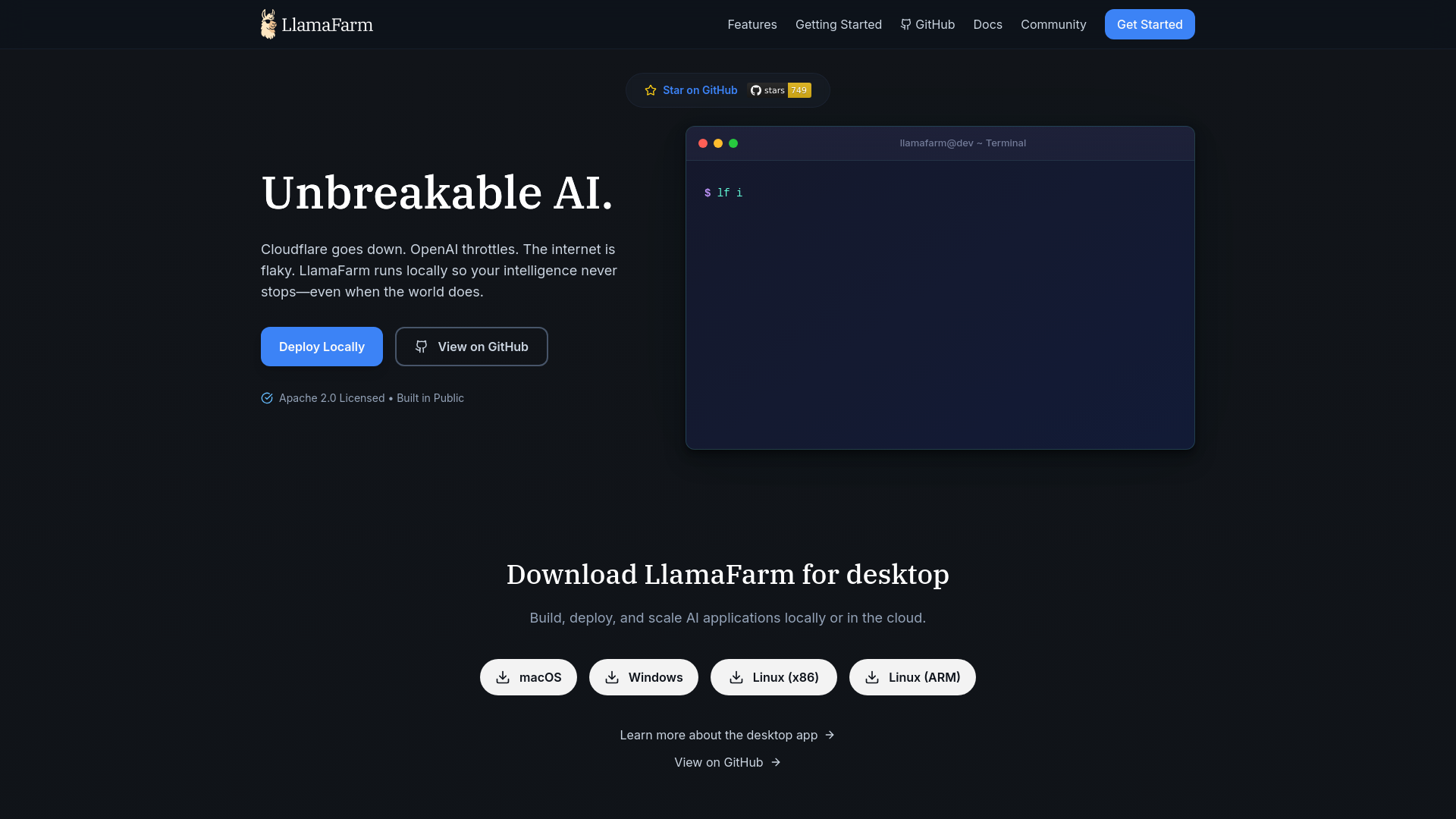
Deploy any AI model and related databases, RAG, agents, and pipelines to any device in 30 seconds. No cloud required.
Run a free AEO + signal audit for your domain.
AI Answer Engine Optimization (AEO)
List once. Convert intent from live AI conversations without heavy integration.
AI deployment is the critical phase of moving a trained machine learning model from development into a live production environment. This process involves integrating the model with existing IT systems, ensuring scalability, security, and reliable performance. Successful deployment turns data science projects into operational assets that drive automation, enhance decision-making, and generate measurable ROI.
Technical teams design the infrastructure, select deployment frameworks, and plan for integration with existing business applications and data pipelines.
The model is packaged into containers or APIs, tested rigorously in staging environments, and optimized for latency, throughput, and resource consumption.
Once live, the model's performance, data drift, and business impact are continuously monitored, with updates and retraining cycles managed to sustain accuracy.
Manufacturers deploy AI models on factory floors to analyze sensor data, predicting equipment failures before they occur and scheduling proactive maintenance.
Financial institutions implement real-time inference engines to scrutinize transaction patterns, instantly flagging anomalous behavior and reducing fraud losses.
Retailers deploy recommendation engines into their digital platforms, dynamically serving personalized product suggestions to boost conversion rates and average order value.
Medical providers integrate diagnostic AI models with imaging systems to assist radiologists in identifying patterns, improving detection speed and accuracy.
Companies deploy NLP models as chatbots or voice assistants to handle customer inquiries, providing instant support and routing complex issues to human agents.
Bilarna evaluates every AI deployment specialist through a proprietary 57-point AI Trust Score. This score rigorously assesses technical certifications, proven project portfolios, and verifiable client satisfaction metrics. We continuously monitor provider performance and compliance to ensure our marketplace connects you only with reliable, expert partners.
AI deployment costs vary widely, from $50,000 for a focused pilot to $500,000+ for enterprise-scale integration, depending on model complexity, infrastructure needs, and required scalability. The primary cost drivers are cloud compute resources, specialized engineering talent, and ongoing maintenance.
AI development focuses on researching, designing, and training machine learning models using historical data. AI deployment is the subsequent engineering discipline of integrating those trained models into live production systems where they can process real-time data and deliver business value.
A standard AI deployment project ranges from 3 to 9 months. Timeline depends on the integration depth with legacy systems, the need for custom MLOps pipelines, and the scope of testing and validation required before go-live.
Key challenges include managing model drift where performance degrades with new data, ensuring low-latency inference at scale, and integrating seamlessly with existing, often siloed, enterprise IT infrastructure. A robust MLOps strategy is essential to overcome these hurdles.
Prioritize providers with proven experience in your industry, demonstrated expertise in MLOps frameworks like Kubeflow or MLflow, and a strong track record of maintaining models in production. Assess their approach to security, scalability, and ongoing monitoring and support.
Use a unified AI platform to accelerate AI deployment and reduce development time. 1. Integrate infrastructure, orchestration, data, and AI agents into a single modular platform. 2. Eliminate the need for glue code by using an integrated AI stack. 3. Move AI projects from prototype to enterprise-ready deployment in half the time compared to traditional multi-vendor setups. 4. Benefit from faster time-to-production and streamlined development processes.
AI accelerates marketing tool creation and deployment by automating key tasks: 1. Use AI prompts to generate mini-tools or features quickly without manual coding. 2. Deploy tools instantly to the internet with one-click publishing options. 3. Leverage AI to create landing pages and marketing content automatically. 4. Continuously improve tools based on AI-driven analytics and user feedback. 5. Reduce development time from days to minutes, enabling rapid experimentation and iteration.
AI-native infrastructure improves software deployment by enabling seamless integration and automation. 1. Deploy AI-driven pipelines that automate testing, integration, and delivery. 2. Use AI to monitor deployment environments and predict potential failures. 3. Automate rollback and recovery processes using AI insights. 4. Optimize resource allocation dynamically based on AI analytics to ensure smooth deployment.
Scale AI employee deployment effectively by following a structured approach. 1. Start by deploying AI employees in one team or department to monitor performance. 2. Customize AI employee roles based on specific team needs and workflows. 3. Implement governance and verification processes to maintain quality and compliance. 4. Train team members to control and interact with AI employees efficiently. 5. Gradually expand deployment to additional teams, adjusting configurations as necessary. 6. Continuously monitor outcomes and optimize AI employee functions for scalability.
Cloud services can be linked together in an application deployment by defining dependencies and communication pathways between them. This often involves configuring service connections, such as linking a web frontend to an API service or connecting an API to a database. By establishing these links, services can interact seamlessly, enabling data flow and functionality integration. Proper linking ensures that the application components work cohesively, improving maintainability and scalability.
Decision science platforms streamline the entire lifecycle of routing and scheduling models by providing developer-friendly tools and workflows. They enable users to build, test, deploy, and operate custom decision models efficiently. These platforms integrate with popular modeling tools and solvers, allowing data scientists and operations researchers to focus on modeling rather than building infrastructure. Additionally, they support validation, monitoring, and autoscaling of models, ensuring reliable performance in real-world applications. Business stakeholders benefit from transparent reporting and the ability to track custom KPIs, enhancing the overall impact of decision models.
Deployment agents play a crucial role in improving software distribution in isolated or air-gapped customer environments by automating the deployment process and enabling remote management. These agents, often implemented via Docker Compose or Helm, manage application deployments, collect logs and metrics, and facilitate remote troubleshooting without requiring direct access to the environment. This automation reduces manual intervention, minimizes errors, and speeds up updates and rollbacks. Additionally, deployment agents help maintain security by operating within the customer's controlled environment, ensuring that sensitive data and operations remain isolated. Overall, they enhance reliability, efficiency, and security in distributing software to protected or disconnected infrastructures.
Developers can test AI applications effectively during continuous integration and deployment (CI/CD) by integrating automated testing tools that validate AI models and their outputs against predefined schemas and expected behaviors. Using type-safe schemas ensures that the AI responses conform to the required data structures, reducing runtime errors. Tools that support test case creation and playground environments allow developers to iterate quickly and verify functionality before deployment. Additionally, automated retries for failed requests and fallback mechanisms improve robustness. Incorporating these practices into CI/CD pipelines helps maintain application quality and reliability throughout development cycles.
Enterprises can secure their applications during deployment by implementing multiple layers of protection. This includes using enterprise-grade authentication systems that integrate seamlessly without requiring code changes. Deployments can be secured through isolated network environments such as Virtual Private Clouds (VPCs), which provide network isolation. IP whitelisting restricts access to trusted IP addresses only, enhancing security. Static IP addresses enable secure database connections by ensuring consistent network endpoints. Additionally, role-based access control and customizable security policies allow granular permission management, ensuring that only authorized users can access sensitive applications and data. These measures collectively ensure robust security throughout the deployment lifecycle.
Human oversight plays a critical role in deploying embodied AI systems in real workplaces by ensuring safety, accuracy, and adaptability. Humans can monitor AI behavior during rollouts, identify edge cases or unexpected failures, and provide recovery data that helps improve the system. This human-in-the-loop approach creates a continuous feedback loop where each deployment generates new experiences that feed back into training datasets. As a result, AI models become more robust and better adapted to the complexities and variability of real-world environments, ultimately enhancing performance and reliability.