Step 1
Machine-Ready Briefs
AI translates unstructured needs into a technical, machine-ready project request.
We use cookies to improve your experience and analyze site traffic. You can accept all cookies or only essential ones.
 Bilarna
Stop browsing static lists. Tell Bilarna your specific needs. Our AI translates your words into a structured, machine-ready request and instantly routes it to verified AI-Powered Data Insights experts for accurate quotes.
AI translates unstructured needs into a technical, machine-ready project request.
Compare providers using verified AI Trust Scores & structured capability data.
Skip the cold outreach. Request quotes, book demos, and negotiate directly in chat.
Filter results by specific constraints, budget limits, and integration requirements.
Eliminate risk with our 57-point AI safety check on every provider.
Verified companies you can talk to directly

Amazon Comprehend, yapılandırılmamış verilerdeki ve belgelerde yer alan metinlerdeki bilgileri ortaya çıkarmak için makine öğrenimini (ML) kullanan bir doğal dil işleme (NLP) hizmetidir.
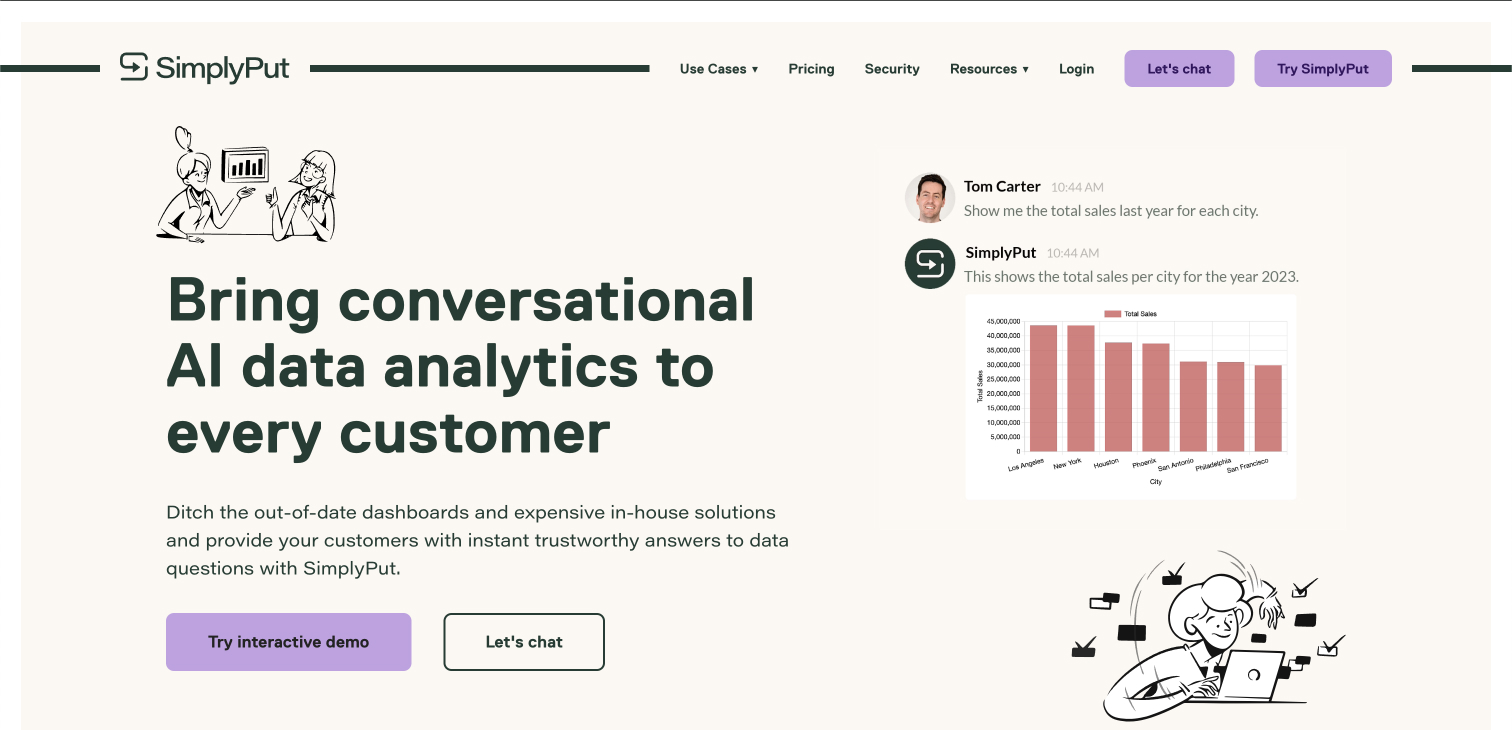
Ditch the out-of-date dashboards and expensive in-house solutions and provide your customers with instant trustworthy answers to data questions with SimplyPut.

Transforming raw data into compelling stories and actionable AI insights in an instant. NarraViz turns raw data into instant, visual business insights. Designed for marketers, analysts, sales teams, and leaders who make decisions at speed. Request a demo Talk to Your Data. Visualize the Truth. NarraterAI - Your convers
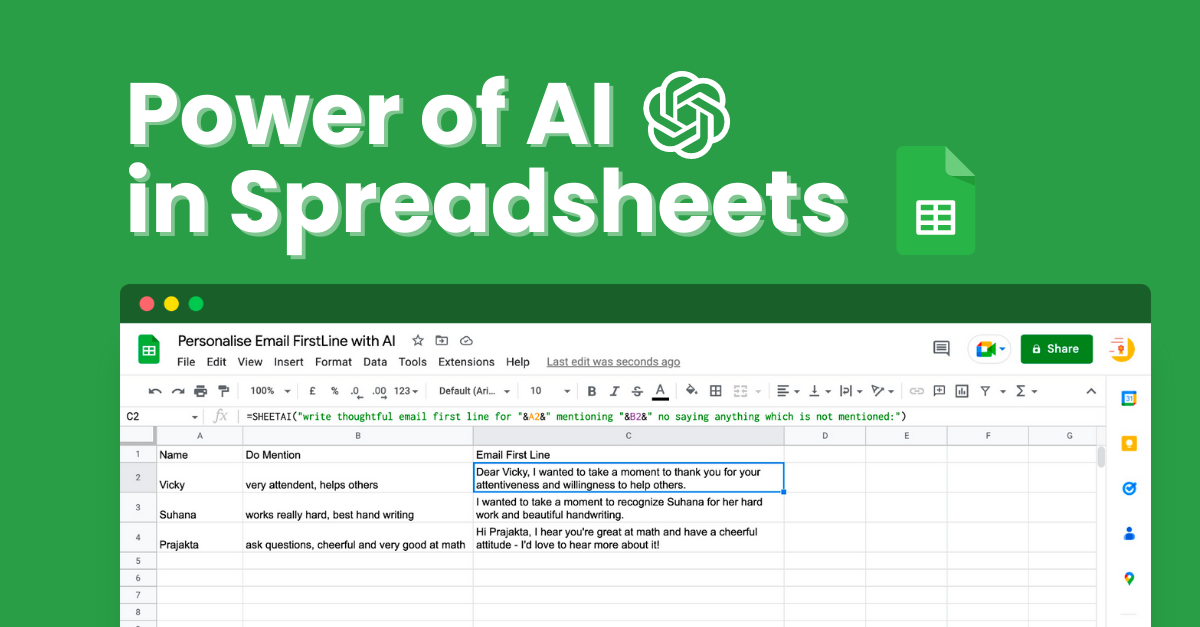
Powerful Google Sheets AI add-on to automate tasks, run AI functions, generate formulas, use ChatGPT in Sheets, & turn a spreadsheet into AI-powered sheet.

Automatic insights on all your company data. Connect your data sources in seconds and get AI-powered visualizations, workflows, machine learning, and analytics with zero learning curve.
Run a free AEO + signal audit for your domain.
AI Answer Engine Optimization (AEO)
List once. Convert intent from live AI conversations without heavy integration.
AI-powered data insights are the process of using machine learning and advanced analytics to extract actionable intelligence from raw data. This approach automates pattern recognition, predictive modeling, and anomaly detection, uncovering trends invisible to manual analysis. It empowers businesses to make data-driven decisions, optimize operations, and predict future market movements with greater accuracy.
Businesses first identify key performance questions and integrate relevant data from internal systems and external streams for a holistic view.
Machine learning algorithms then process this data to perform tasks like forecasting, clustering, and sentiment analysis automatically.
Insights are presented through dashboards and reports, enabling teams to implement strategic changes based on concrete evidence.
Banks use predictive analytics to assess credit risk, detect fraudulent transactions in real-time, and forecast market volatility.
Hospitals apply ML models to patient data to predict readmission risks, personalize treatment plans, and optimize resource allocation.
Retailers analyze browsing and purchase history to deliver personalized product recommendations and dynamic pricing strategies.
AI monitors sensor data to predict equipment failures, optimize logistics routes, and manage inventory levels proactively.
Software companies track user behavior to identify feature adoption trends, reduce churn, and guide product development roadmaps.
Bilarna ensures quality by evaluating every AI-powered data insights provider with a proprietary 57-point AI Trust Score. This score rigorously assesses technical expertise, project delivery reliability, data security compliance, and verified client satisfaction. Providers are continuously monitored to maintain their trusted status on the platform.
Costs vary significantly based on project scope, data complexity, and required expertise, ranging from monthly SaaS subscriptions to large custom enterprise contracts. Factors like real-time processing needs and the level of predictive modeling directly influence the final price.
A typical project timeline spans from 3 to 9 months, covering phases for data readiness, model development, testing, and deployment. The duration depends on data quality, integration complexity, and the sophistication of the desired analytical models.
Evaluate providers based on their proven industry expertise, relevant technical certifications, and a strong portfolio of case studies. Key selection criteria should also include their approach to data governance, scalability of solutions, and post-implementation support structure.
Common pitfalls include starting with poor quality or siloed data, lacking clear business objectives for the AI, and underestimating the need for ongoing model maintenance and tuning. Success requires cross-functional alignment and treating AI as an iterative process.
ROI manifests as increased operational efficiency, higher customer retention, reduced risks, and new revenue opportunities from data-driven products. Tangible outcomes often include double-digit percentage improvements in key metrics like forecast accuracy and cost reduction.
Yes, the AI-powered teacher tools are free and include the following features: 1. Worksheet Generator to create custom worksheets quickly. 2. Lesson Plan Generator for comprehensive, standards-aligned lesson plans. 3. Report Card Comments generator for professional, personalized feedback. 4. Coloring Page Generator to turn ideas into printable coloring pages. 5. All tools save your work automatically to a cloud library accessible from any device. 6. Tools are private, secure, and supported with fast in-app chat assistance.
To understand data upload limits and payment requirements on analytics platforms, follow these steps: 1. Review the platform's account types, such as free and paid plans. 2. Check the data upload limits for each plan; free accounts often have row limits per upload. 3. Determine if a credit card is required for free or paid accounts. 4. Understand the cancellation policy for paid subscriptions, which usually allows cancellation at any time.
Yes, AI RFP software typically integrates with a wide range of existing business tools such as CRM platforms, collaboration software, cloud storage services, and knowledge management systems. This seamless integration allows users to leverage their current data sources and workflows without disruption. Regarding security, reputable AI RFP solutions prioritize data protection through measures like end-to-end encryption, compliance with standards such as SOC 2, GDPR, and CCPA, and role-based access controls. Data is never shared with third parties, ensuring confidentiality and compliance with privacy regulations.
Yes, many AI-powered browsers built on Chromium technology are compatible with Chrome extensions, allowing users to continue using their favorite add-ons without interruption. These browsers often support seamless import of existing browser data such as bookmarks, passwords, and extensions from Chrome, making the transition smooth and convenient. This compatibility ensures that users do not lose their personalized settings or tools when switching to an AI-enabled browser. By combining AI capabilities with familiar browser features, users can enhance productivity while maintaining their preferred browsing environment.
Yes, an AI-powered authoring platform can handle complex academic content effectively. To do so: 1. Use LaTeX or MathML support to create, edit, and validate complex STEM equations accurately. 2. Integrate with reference databases such as CrossRef, PubMed, and ORCID for real-time reference verification and linking. 3. Apply automatic formatting and style consistency to references and citations. 4. Edit text, tables, and figures with AI assistance to maintain accuracy. 5. Manage author queries and communication within the platform to resolve content issues. 6. Export structured, publication-ready outputs in XML and PDF formats. This ensures precise handling of technical academic content, improving quality and efficiency in scholarly publishing.
Anonymous statistical data cannot usually be used to identify individual users without legal authorization. To ensure this: 1. Collect data without personal identifiers or tracking information. 2. Avoid combining datasets that could reveal user identities. 3. Use data solely for aggregated statistical analysis. 4. Obtain a subpoena or legal order if identification is necessary. 5. Maintain strict data governance policies to protect user anonymity.
Yes, conversation intelligence platforms provide summaries and actionable insights from meetings by analyzing recorded conversations. 1. Upload or record your meeting audio or video. 2. The platform transcribes the conversation and identifies key topics and contributors. 3. It analyzes emotional tone, pain points, customer preferences, and open questions. 4. Generates concise summaries highlighting important discussion points and action items. 5. Use these insights to guide decision-making, follow-up actions, and strategic planning.
Many modern data analytics platforms are designed to integrate seamlessly with your existing technology infrastructure. This means you do not need to replace your current systems to start using the platform. These solutions are built with flexibility in mind, allowing them to sit on top of your existing ecosystem without requiring extensive integration work on your part. This approach helps organizations adopt new analytics capabilities quickly while preserving their current investments in technology. It is advisable to check with the platform provider about specific integration options and compatibility with your current setup.
Data collected exclusively for anonymous statistical purposes cannot usually identify individuals. To maintain anonymity, follow these steps: 1. Remove all personal identifiers from the data. 2. Use aggregation techniques to combine data points. 3. Avoid storing detailed individual-level data. 4. Limit access to the data to authorized personnel only. 5. Regularly review data handling practices to ensure anonymity is preserved.
Yes, you can add external data sources to enhance your AI presentation by following these steps: 1. Start by entering your presentation topic into the AI generator. 2. Add a data source such as a website URL, YouTube link, or PDF document to provide additional context. 3. The AI will analyze the data source to create richer and more accurate content. 4. Review and export your enhanced presentation in your desired format.